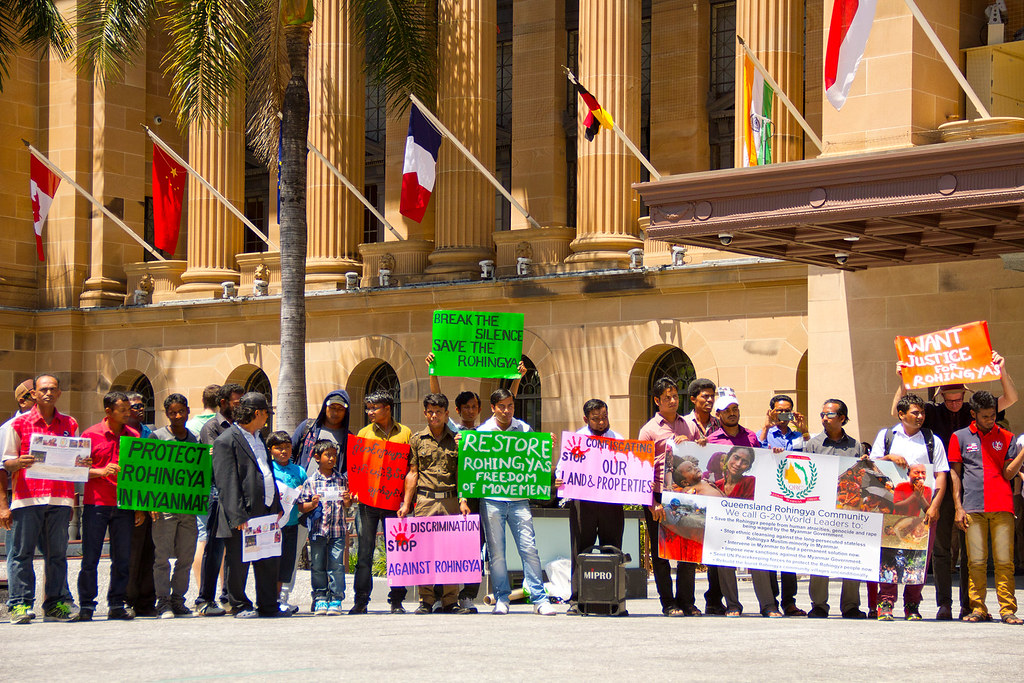
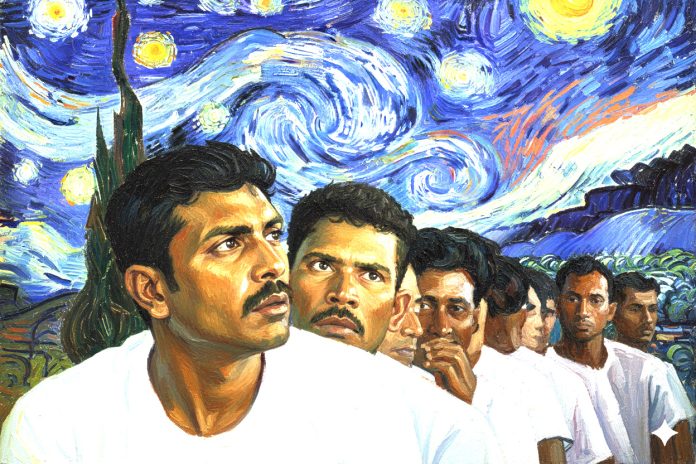
Misinformation about Rohingya refugees often starts in Myanmar and Bangladesh, then spreads across borders and shapes public opinion throughout South Asia. Images and videos from refugee camps in Bangladesh are reused in anti-immigrant narratives against the Rohingya, stateless Muslim refugees who have been forced to flee Myanmar due to an ongoing genocide and oppression against them.
Rohingya Protesters pushing for change in Myanmar at the G20 in Brisbane, Australia. Image via Flickr by Andrew Mercer. CC BY-NC-SA 2.0.
Originally published at Global Voices in December 2025.
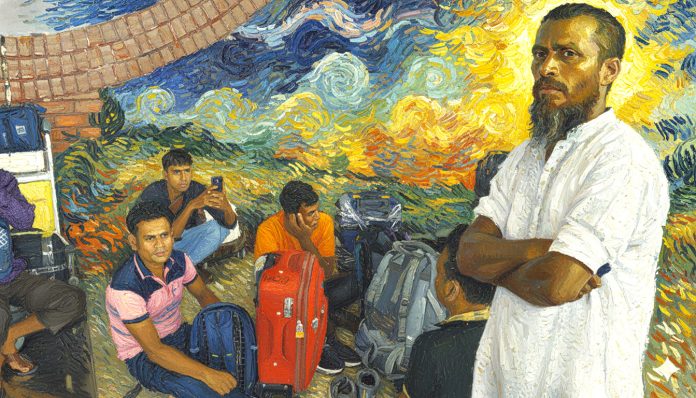
The migration journey of Bangladeshi workers is increasingly mediated through informal networks that expose prospective migrants to misinformation, deception, and exploitation.
Despite rising reliance on online recruitment and remittance systems, little is known about how misleading information propagates across the migration lifecycle.
Building on recent evidence of digital recruitment scams and pervasive “free-visa” schemes, this study investigates how misinformation is produced and circulated, which actors exploit digital and interpersonal channels, and which digital-literacy deficits most strongly mediate harm.
Importantly, findings will inform policy and practice: strengthening digital literacy curricula, verification mechanisms, and harmonising regulatory oversight across recruitment pipelines can mitigate the harms documented.
Finally, the research calls for rigorous evaluations of digital-literacy interventions and cross-sector collaborations to foster safer migration pathways.
Digital recruitment scams: A nightmare for thousands of Bangladeshi migrants
Migrants’ digital vulnerability—the inability to authenticate online information and verify recruitment legitimacy—now sits at the heart of Bangladesh’s migration crisis
In recent years, the migration dreams of thousands of Bangladeshi workers have turned into digital nightmares. Social platforms that promise safer pathways to overseas employment have instead become primary vectors for recruitment scams, sophisticated fraud, online exploitation, and digital deception.
Digital Battlefield of Statelessness: Disinformation, Hate Speech, and the ‘Victim-to-Threat’ Narrative on Rohingya in South and Southeast Asia
This study explores the digital battlefield where the Rohingya crisis continues to be reframed by disinformation, state-sponsored propaganda, online hate campaigns, and politically driven narratives. While the visible consequences—forced displacement, statelessness, and violence in refugee camps—have drawn significant international attention, the covert spread of anti-immigrant narratives and disinformation against the Rohingya community has remained insufficiently examined.
From viral social media content to misleading headlines in mainstream media, Rohingya identity has been repeatedly weaponised to fuel public fear and reframe humanitarian crises as national security threats. Anti-immigrant narratives and disinformation now demonstrate how the “victim-to-threat” framing of the Rohingya crisis functions not only as a discursive shift but also as a threat multiplier within the security landscape of South and Southeast Asia.
In countries such as Indonesia, India, Bangladesh, Myanmar, and Pakistan, these narratives have not only shaped local attitudes but also fostered regional distrust and diplomatic friction. For instance, false stories about criminal activity and militant affiliations have circulated widely on TikTok, Facebook, and WhatsApp, portraying the Rohingya as a threat. Similarly, unverified claims linking Pakistan’s intelligence agency to armed Rohingya groups in Bangladesh have spread broadly, heightening suspicions between neighbouring states. These cases highlight how disinformation transcends borders, exploits geopolitical divisions, and turns stateless people into targets of manufactured hostility.
Identify how these narratives are shaped and amplified by local political agendas, militarised state media, and digital platforms.
Expose structural gaps in regional digital rights frameworks that often overlook the digital vulnerability of stateless communities.
Drawing on insights from academia, digital rights journalists, fact-checkers, and regional stakeholders, this study will analyse recurring disinformation patterns—depicting the Rohingya as terrorists, criminals, demographic threats, or burdens on host societies. It will further illustrate how disinformation flows influence policy decisions, humanitarian violations, and regional discourse.
This research contributes to digital migration studies by showing how the “victim-to-threat” narrative functions as a threat multiplier in the security nexus of South and Southeast Asia. It also challenges dominant digital rights frameworks in refugee crisis discourse and advocates for a collaborative response that amplifies the voices of stateless and displaced communities online.
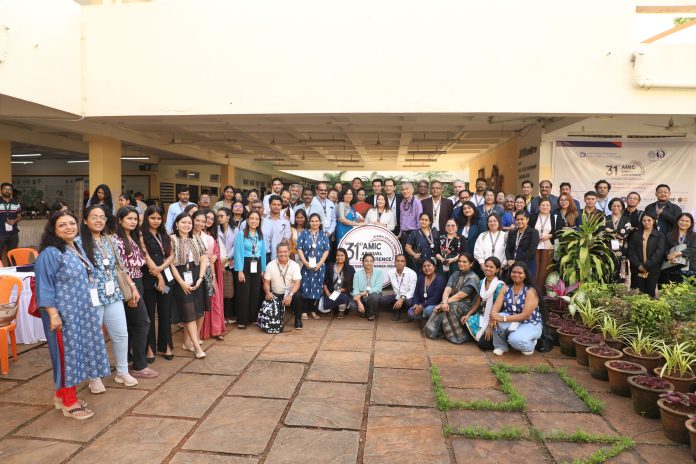
The committee of the 31st AMIC Conference has accepted two research abstracts by Zulker Naeen, an adjunct faculty member, and Sarkar Barbaq Quarmal, PhD, an Associate Professor in the Department of Media Studies and Journalism at the University of Liberal Arts Bangladesh (ULAB).
The conference ran from 9 to 11 October 2025 in Mumbai, India, and centred on the theme “Navigating Digital Transformation in Media, Public Relations, and Advertising.”
The organisers selected both abstracts after a rigorous blind peer review. They confirmed acceptance on 22 and 23 September 2025.
It sits under Theme C: Ethical Issues and Concerns in Going Digital, so it speaks directly to the conference’s question of whether ethics belongs in the digital transformation equation.
Consequently, the authors set out to build a governance framework that Bangladeshi universities can apply when they teach communication, media and journalism with artificial intelligence.
Therefore, the study echoes the conference objective of envisioning curricula to bring digital innovation and industry needs to the forefront.
Together, the two papers connect ethics with capacity. Governance sets the rules for responsible AI use, while professional development gives faculty the skills to follow them.
As a result, the work offers Bangladesh’s journalism and media educators a practical route into a changing field. The acceptance reflects growing scholarly interest in how South Asian institutions prepare the next generation of communicators for a digital future.
Readers can browse the full parallel sessions schedule on the conference website.
Root Cause Analysis of Digital Vulnerability of Bangladeshi Migrant Workers
In recent years, Bangladeshi aspirant migrant workers and immigration seekers have become primary targets of sophisticated online fraud, recruitment scams, and financial deception. These threats — delivered via social media groups, messaging apps, fake mobile apps, online betting traps, and fraudulent payment flows — have reached deep into villages and vulnerable communities.
Map how digital deception reaches aspirant workers at the village level.
Analyse classical cases showing recurring scam modalities using migration networks.
Co-design a practical, low-literacy curriculum and delivery model for digital & financial literacy suited to grassroots contexts.
Outcomes
This study identifies the common digital recruitment scams and fraud techniques that are targeting Bangladeshi aspirants. Which institutional factors drive digital vulnerability? How do aspirant migrant workers’ digital behaviours and financial practices interact with scam vectors?
This initiative will move beyond symptom-spotting to identify root causes and produce practical solutions — an evidence-based curriculum and pilot that can be taken up by BMET, CSOs, and community trainers.
Keywords
Migration Risk, Digital Vulnerability, Digital Literacy, Recruitment Network, Cross-border Syndicates, Digital Scams
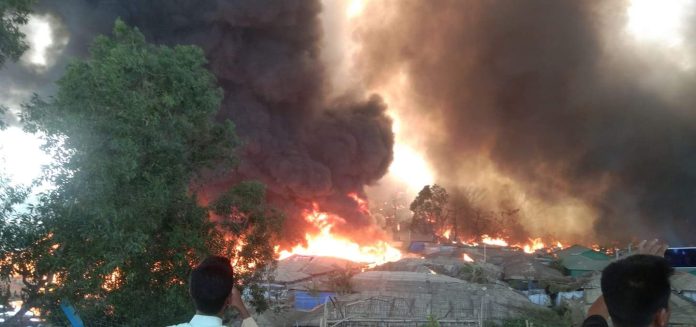
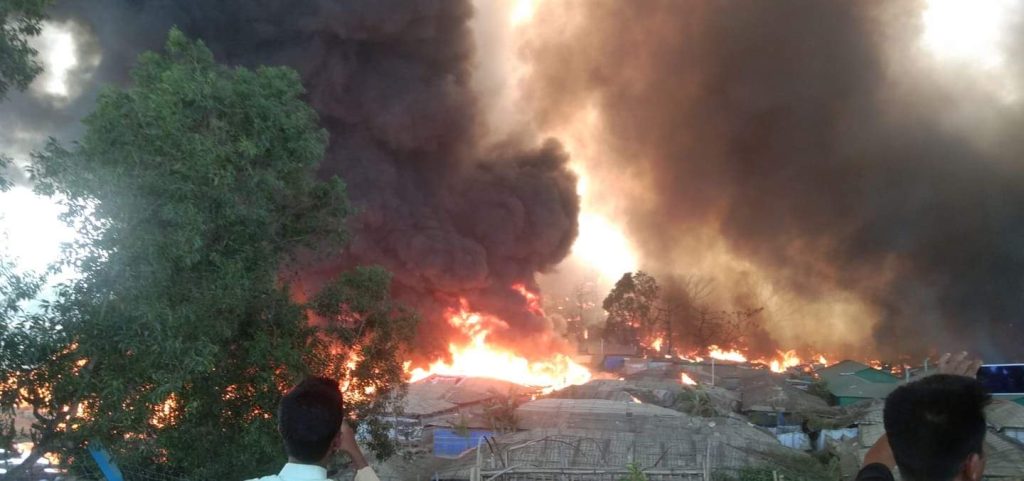
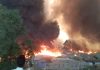
March 2021 Rohingya refugee camp fire by Rocky Masum is licensed under CC BY-SA 4.0.
Abstract
Since August 2017, approximately one million Rohingya refugees fleeing genocidal violence in Myanmar established the world’s largest and most densely populated refugee settlement in Cox’s Bazar, Bangladesh. Within this protracted displacement context, fire incidents have emerged as a defining humanitarian catastrophe, with 2,425 documented fires between May 2018 and December 2025 affecting over 100,000 individuals and destroying more than 20,000 shelters.
This investigation is structured around a primary research question: What are the root causes of fire incidents in Rohingya refugee camps in Cox’s Bazar, Bangladesh, and how do structural-accidental fires differ from deliberate arson in terms of causation, frequency, and impact?
The primary objective of this research is to systematically document, analyse, and explain the root causes and perpetrators of fire incidents in the Rohingya refugee camps of Cox’s Bazar, Bangladesh, between 2017 and 2026, with particular emphasis on distinguishing between structural-accidental fires and deliberate arson orchestrated by armed groups.
This research employs a mixed-methods approach combining qualitative systematic literature review of 55 primary and secondary sources, critical discourse analysis of government investigation reports and humanitarian agency assessments, spatial-temporal mapping of fire incidents across camp blocks and seasons, and triangulation of English-language international reporting with Bangla-language national media coverage to capture both external and domestic framings of the crisis.
A sampling strategy utilising purposive and snowball techniques was employed to identify all accessible reports that met the inclusion criteria: direct coverage of fire incidents in Cox’s Bazar camps, published between 2017 and 2026, featuring causal analysis beyond mere incident description.
This research not only extends conflict studies literature on the use of arson as a weapon in contested governance spaces but also provides evidence-based recommendations for humanitarian actors regarding the inadequacy of technical fire safety interventions that have failed to address the governance dimension.
Ultimately, the study highlights the most fundamental protection concern—the right to shelter that does not burn—remains unaddressed after eight years of encampment, severe inadequacies of temporary humanitarian responses to what have become permanent displacement situations.
Bridging Research and Practice: Media Professionals Tackle Cross-Border Misinformation in Forced Displacement Coverage
“From statelessness to digital voicelessness” fact-checking workshop at Beyond Borders Asia 2.0 conference
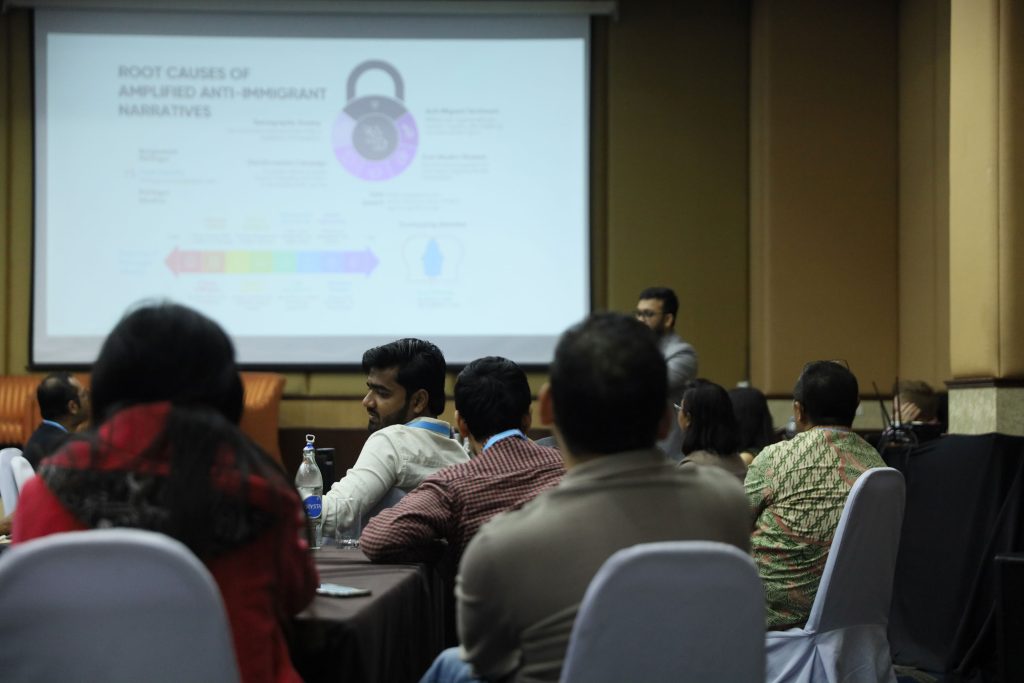
On February 8, 2026, in the main conference hall of Duangtawan Hotel, more than seventeen media professionals and journalism experts from across South Asia and Southeast Asia gathered for a session that would challenge how they approach one of the region’s most complex humanitarian stories.
Throughout the dedicated one-hour session, facilitator Zulker Naeen guided participants through a journey that began with research findings and evolved into collaborative, hands-on learning.
The Rohingya situation, serving as the session’s focal case study, demonstrates how humanitarian suffering transforms into contested narratives online, with disinformation and propaganda flowing across national boundaries from Myanmar into Bangladesh, India, and other neighbouring countries.
Initially, the facilitators shared research evidence documenting patterns of cross-border misinformation and the mechanisms through which anti-migrant narratives gain traction online. Subsequently, the session shifted into interactive mode, where participants actively engaged with concrete fact-checking techniques tailored specifically to displacement reporting.
The Rohingya crisis is not only unfolding on the ground but also in the digital sphere, where disinformation, propaganda, and hate campaigns migrate across borders—from Myanmar to Bangladesh, India, and beyond—transforming humanitarian suffering into scrutinised fiction.
Using the Rohingya case as a focal example — “From statelessness to digital voicelessness” — participants have learned concrete fact-checking techniques, examined how hate speech and state-led narratives spread online, and co-created a guideline to ensure ethical, inclusive, and impactful journalism across South Asia.
This session developed a context-specific, practical fact-checking guide for journalists, media professionals, content creators, and experts based in Asia who report on forced displacement, refugees, migrants, and host communities. Through a highly interactive workshop, the session addressed one problem: the rise of cross-border misinformation and anti-migrant narratives that silence displaced populations.
By combining evidence from research and collaborative guidelines, this session aims to support media professionals in producing accountable reporting that protects the rights and dignity of the displaced community.
The session’s placement within the broader Beyond Borders Asia 2.0 conference, supported by the German Federal Ministry for Economic Cooperation and Development, underscored the international recognition that journalism about refugees, migrants, and host communities requires specialised knowledge and ethical rigour.
By the session’s conclusion, participants possessed not only enhanced technical skills in verification but also a deeper understanding of their role in either amplifying or countering the narratives that shape public attitudes toward displacement.
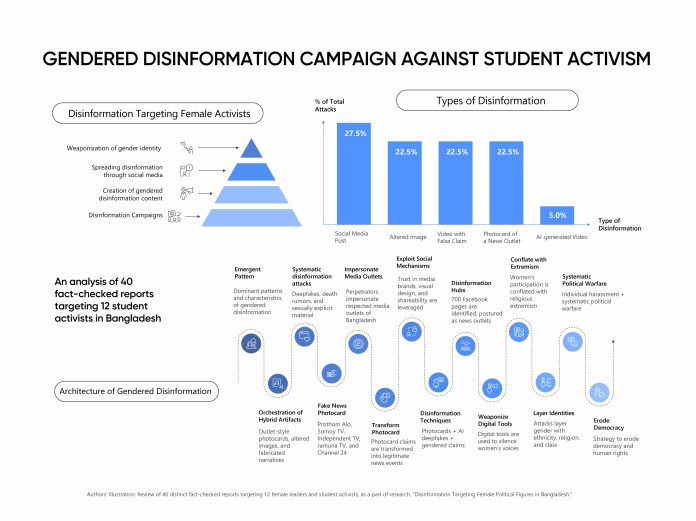
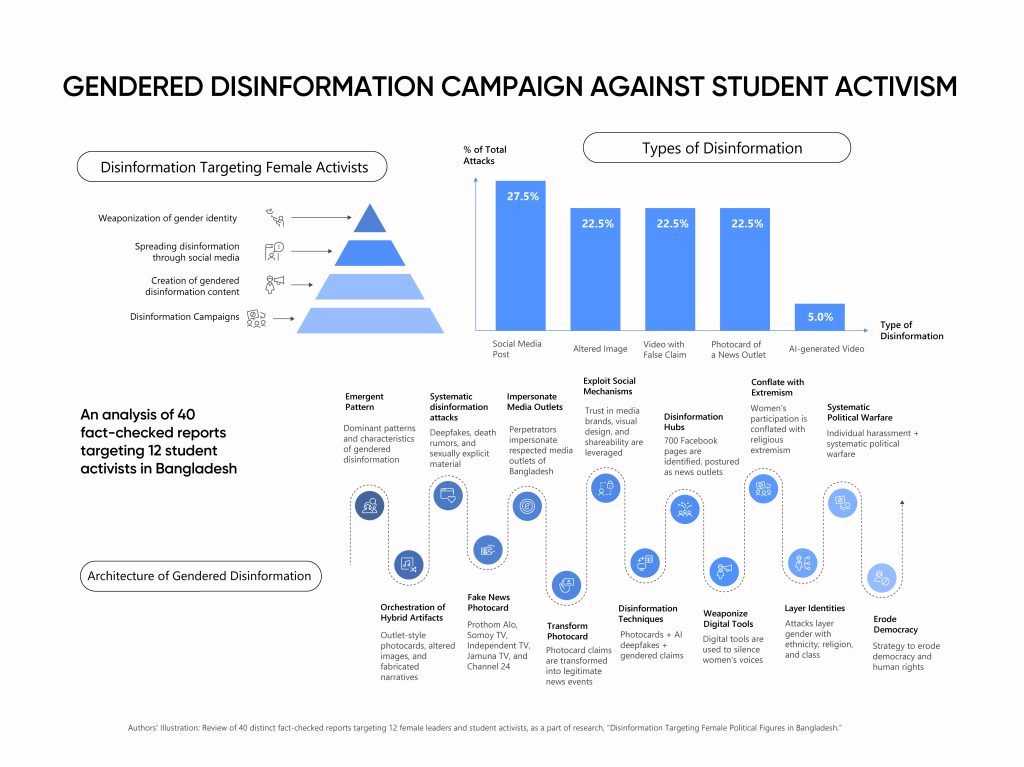
Following Bangladesh’s July 2024 uprising, many female student leaders joined the National Citizen Party (NCP). This new political formation emerged in February 2025 as the first student-led party in Bangladesh’s history. Tasneem Zara, Samanta Sharmin, Nusrat Tabassum, and other student activists became prominent leaders and electoral candidates. Their entry into formal politics triggered a dramatic escalation in disinformation attacks.
A recent research, “Disinformation Targeting Female Political Figures in Bangladesh”, investigates how gendered disinformation is produced, circulated, and weaponised against female leaders and student activists in Bangladesh.
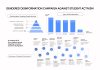
It highlights the dominant patterns of gendered disinformation during a heightened political situation. It reviewed 40 distinct fact-checked reports concerning 12 female student activists, constituting 22.7% of the overall sample.
Between 2024 and 2025, at least twelve female leaders and student activists faced systematic disinformation attacks involving deepfakes, fabricated news reports, death rumours, and sexually explicit material falsely attributed to them.
Author’s Illustration
Read more by clicking the article’s original link.
Originally published at Dhaka Tribune on January 31, 2026.
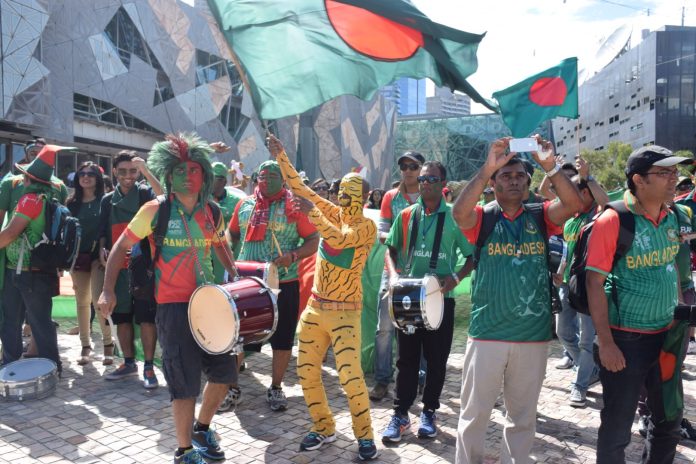
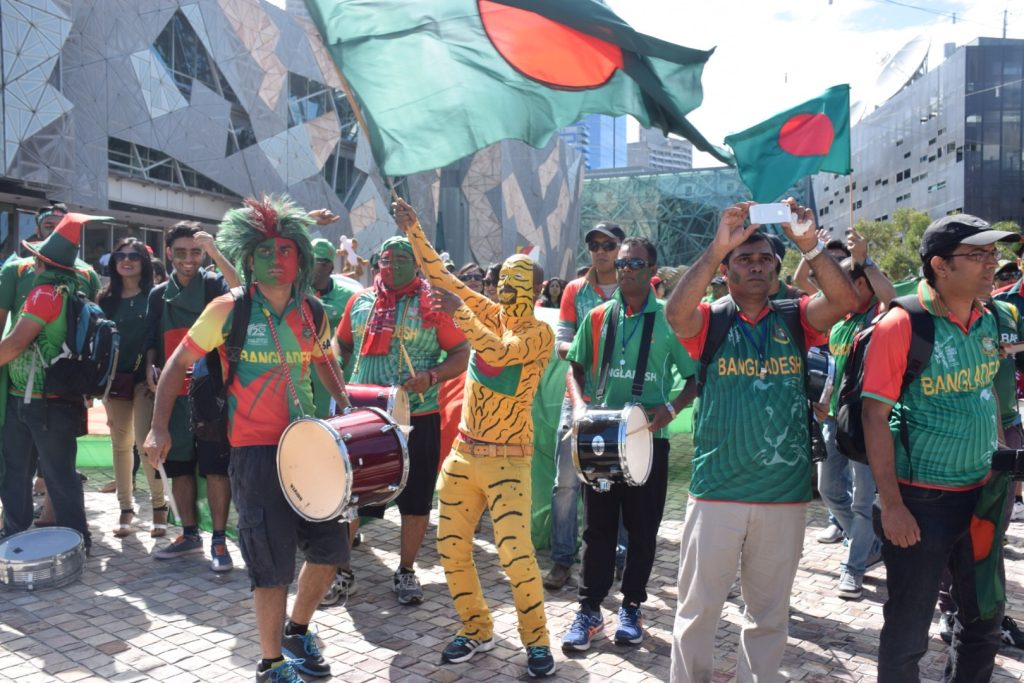
Supporters at the India vs Bangladesh CWC15 quarter final at the MCG, Australia. Image via Flickr by Tourism Victoria. CC BY 2.0.
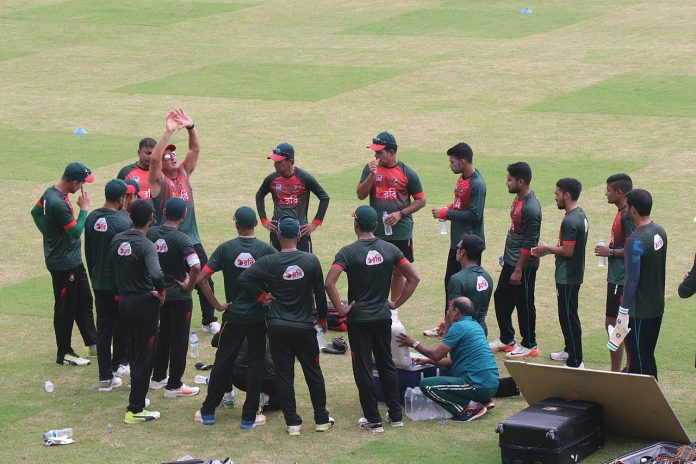
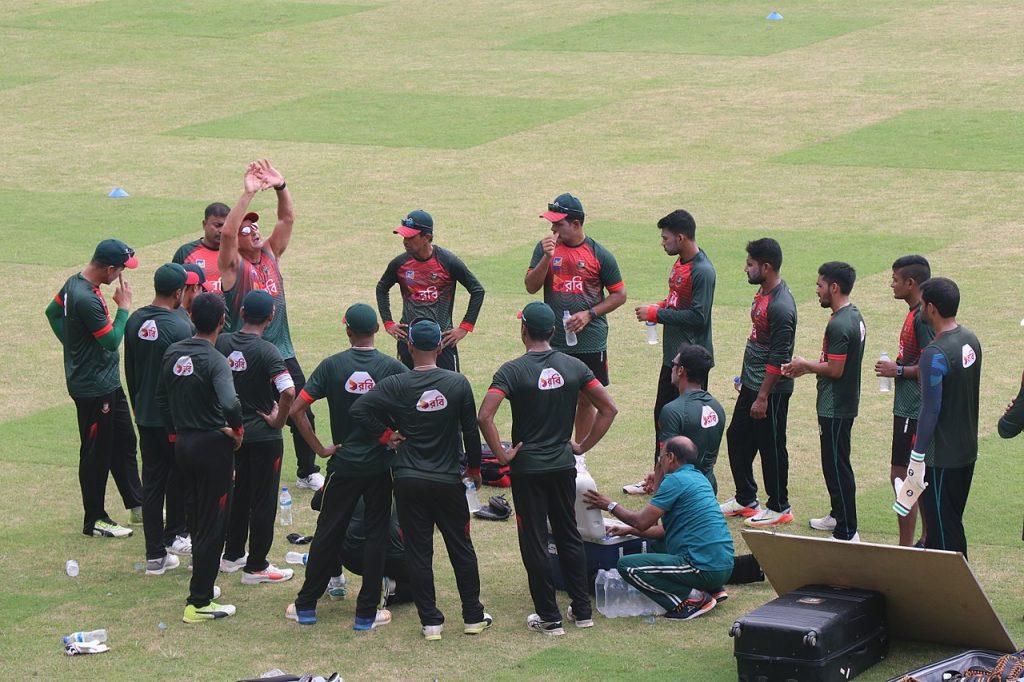
The 2026 T20 Cricket World Cup, the biennial event organised by the International Cricket Council (ICC), is meant to celebrate cricket’s global reach; it has instead exposed the fault lines where sport, security, and statecraft collide with unwanted consequences.
Bangladesh has refused to participate in matches scheduled on Indian soil due to security concerns and political tensions. However, the unfolding cricket crisis represents far more than a diplomatic standoff or a security dispute.
When the Board of Control for Cricket in India (BCCI) instructed the Kolkata Knight Riders to release the Bangladeshi pacer from their IPL 2026 squad due to security concerns, they inadvertently created a logical conundrum that Bangladeshi officials quickly seized upon.
Read more by clicking the original link of the article.
Originally published at Global Voices on January 19, 2026.
How Online Misinformation Pushed Cricket Diplomacy to the Brink
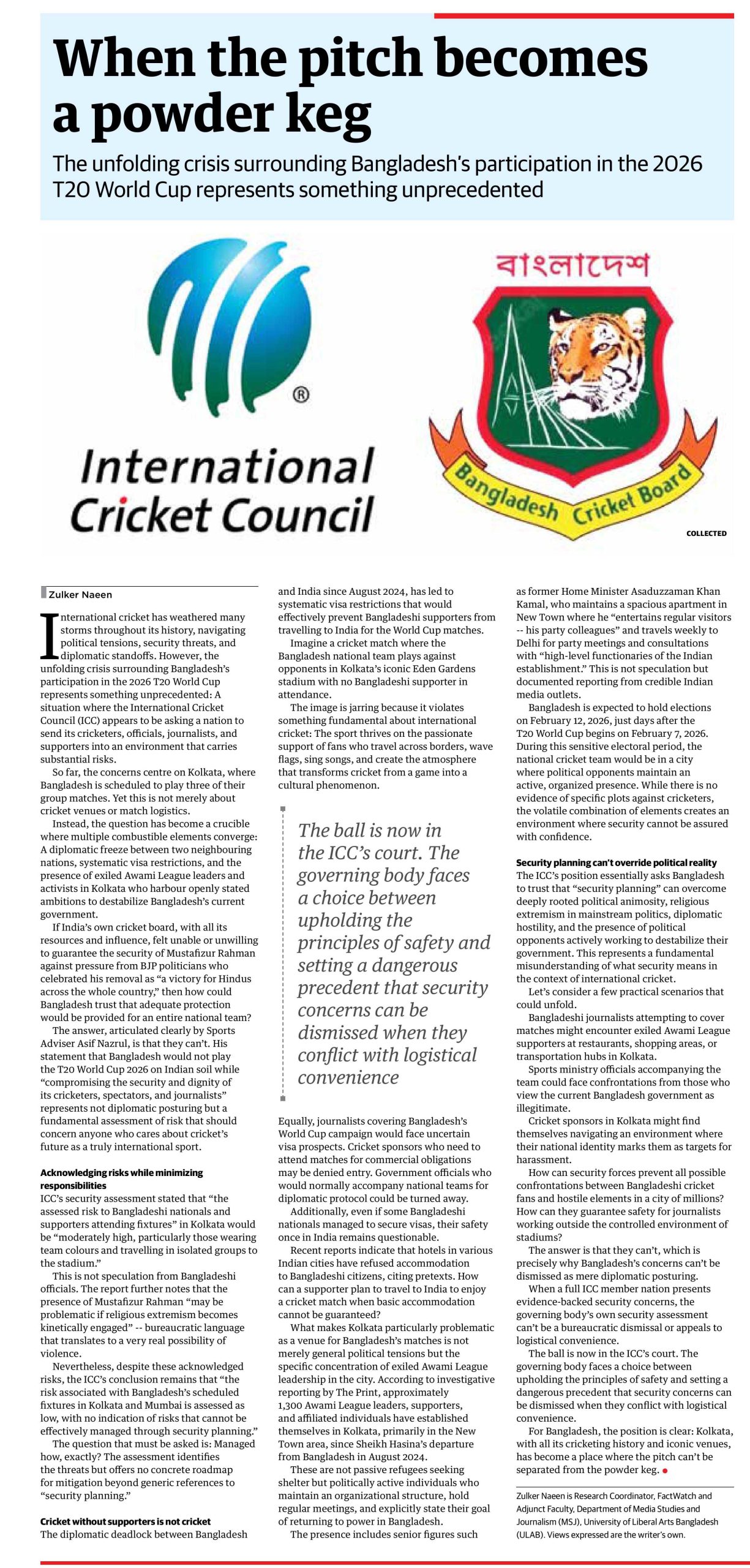
International cricket has weathered many storms throughout its history, navigating political tensions, security threats, and diplomatic standoffs. However, the unfolding crisis surrounding Bangladesh’s participation in the 2026 T20 World Cup represents something unprecedented: a situation where the International Cricket Council (ICC) appears to be asking a nation to send its cricketers, officials, journalists, and supporters into an environment that carries substantial risks.
So far, the concerns centre on Kolkata, where Bangladesh is scheduled to play three of their group matches. Yet this is not merely about cricket venues or match logistics. Instead, the question has become a crucible where multiple combustible elements converge: A diplomatic freeze between two neighbouring nations, systematic visa restrictions, and the presence of exiled Awami League leaders and activists in Kolkata who harbour openly stated ambitions to destabilise Bangladesh’s current government.
The electronic version of the article, retrieved from the website
Read more by clicking the original link of the article.
Originally published at Dhaka Tribune on January 9, 2026.
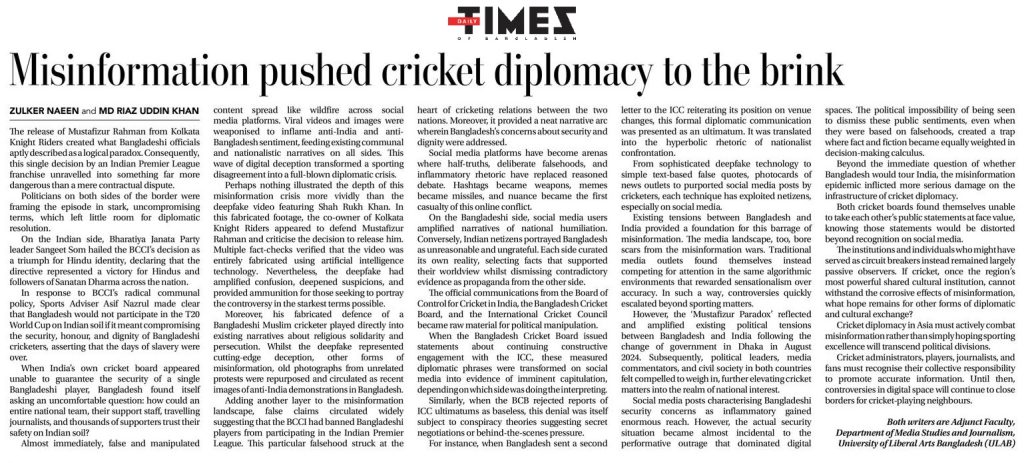
The release of Mustafizur Rahman from Kolkata Knight Riders created what Bangladeshi officials aptly described as a logical paradox. Consequently, this single decision by an Indian Premier League franchise unravelled into something far more dangerous than a mere contractual dispute.
Politicians on both sides of the border were framing the episode in stark, uncompromising terms, which left little room for diplomatic resolution.
Electronic version of the published report
Read more by clicking the original link of the article.
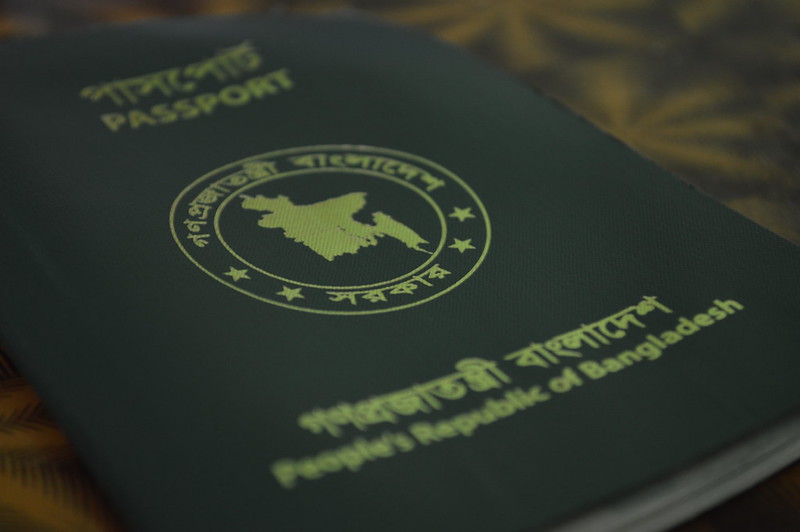
“Bangladeshi Passport” by Moin Uddin is licensed under CC BY-NC 2.0. Visit the link to view a copy of this license.
The green Bangladeshi passport, once a symbol of hope and opportunity for millions seeking better lives abroad, has become a liability at immigration counters worldwide. What unfolds daily at airports across Southeast Asia, Western Asia, and beyond is not merely a migration crisis but a systematic breakdown of trust, governance, and human dignity. Thousands of Bangladeshi citizens stand at immigration desks with valid visas in hand, only to be turned away, detained, and deported without clear explanations.
“Bangladeshi Passport” by Moin Uddin is licensed under CC BY-NC 2.0. Visit the link to view a copy of this license.
On August 13, 2025, Malaysian immigration authorities denied entry to 204 Bangladeshi nationals at Kuala Lumpur International Airport. The passengers were sent back to Bangladesh, their dreams of overseas work shattered before they could even exit the airport. This incident came after earlier mass deportations of 96 on July 11, 123 on July 24, and 80 on July 25. These travellers had valid visas, proper documentation, and airline tickets. Yet they never made it past immigration.
Read more by clicking the original link of the article.
Originally published at GlobalVoices on January 9, 2026.
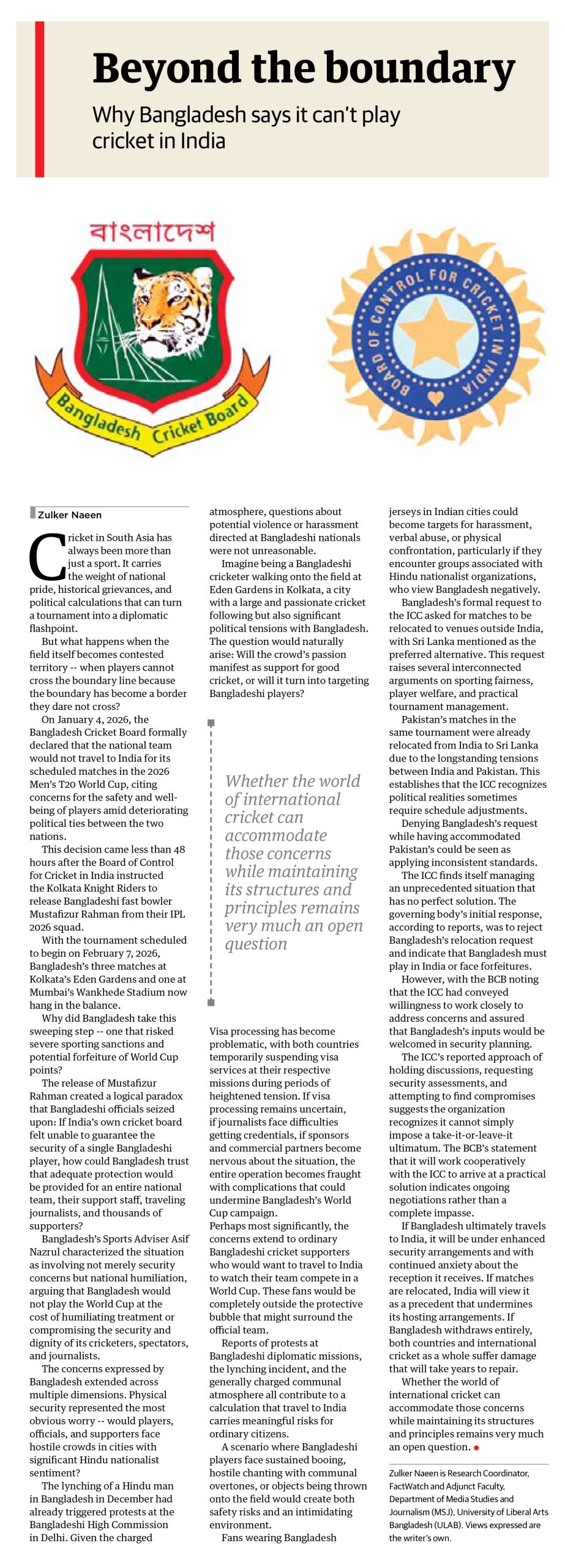
Beyond the boundary: Why Bangladesh says it can’t play cricket in India
Cricket in South Asia has always been more than just a sport. It carries the weight of national pride, historical grievances, and political calculations that can turn a tournament into a diplomatic flashpoint. But what happens when the field itself becomes contested territory—when players cannot cross the boundary line because the boundary has become a border they dare not cross?
The electronic version of the article, retrieved from the website
Read more by clicking the original link of the article.
Originally published at Dhaka Tribune on January 9, 2026.
He completed a Bachelor’s in Media Studies & Journalism and a Master’s in Communication at the University of Liberal Arts Bangladesh (ULAB). Later, he expanded his theoretical grounding with a Master’s in Development Studies from the Independent University, Bangladesh (IUB), a combination that underpins his work bridging scholarly inquiry and field-facing practice.
Bridging Research & Practice in Disinformation Studies and Digital Citizenry
This layered disciplinary foundation enables him to deploy communication theory, journalistic method and development frameworks in the analysis and design of interventions that address information disorder, civic literacy and grassroots problems.
His classroom practice is informed by hands-on verification work and project leadership carried out through Fact-Watch and regional collaborations. He helps translate empirical research into teachable modules and active learning exercises.
Zulker’s research focus is organised around Digital Media and Information Studies, Synthetic Media Studies, Digital Literacy and Digital Citizenry, and their intersections with gender, democracy and civic participation.
He studies how narratives move across platforms and borders, how synthetic media technologies alter evidentiary practices, and how gendered power relations shape both the production and effects of false information; his writings and policy commentaries articulate the theoretical stakes while proposing concrete institutional and pedagogical responses.
In published essays, he has traced the transnational dynamics of disinformation in South Asia, argued for whole-of-society approaches to fact-checking, and documented how misinformation is weaponised against women—each piece grounded in empirical observation and oriented toward practice.
Practically, his work blends qualitative field research with open-source digital forensics and OSINT techniques. He leverages mixed methods—ethnographic interviews, content and discourse analysis, geolocation and metadata verification—to reconstruct information supply chains and attribute patterns of coordinated inauthentic behaviour.
Throughout his career, he has actively translated research into curriculum and capacity building. He has designed specialised training modules and short courses on basic fact-checking and verification toolkits for grassroots practitioners. These pedagogical products are tailored to the needs of journalists in Bangladesh and the broader South Asia region, and are deployed in workshops, fact-checking schools and university classrooms.
His curriculum development emphasises locally-situated problem sets, hands-on verification labs, and gender-sensitive safeguards, ensuring that training is both technically rigorous and ethically attentive.
At the same time, his leadership in regionally focused projects—such as contributing to a draft strategy for South Asian collaboration on transnational misinformation—illustrates how his scholarship moves beyond description to institutional design and policy engagement.
That pathway equips him with a rare combination of strategic communications skills, investigative craft, and curriculum design expertise, enabling him to operate as an interdisciplinary researcher-development practitioner who can convene scholars, train journalists, advise policymakers and support grassroots actors.
In public fora and peer networks, he positions Disinformation Studies as an applied, action-oriented discipline—one that requires methodological pluralism, ethical reflexivity and sustained investment in digital literacy and civic capacity.
His work therefore insists that solutions to information disorder must integrate pedagogical interventions, verification infrastructures, cross-border cooperation and gender-aware policies, and his published commentaries and project briefs offer concrete recommendations for each of these domains.
South Asia faces an urgent crisis of weaponised misinformation targeting refugees and migrants. This regional study examines systematic patterns of anti-immigrant narratives across India, Bangladesh, Pakistan, Nepal, and the Maldives. Our research team, comprising scholars from the discipline of misinformation studies, analyses how digital platforms transform humanitarian crises into political ammunition.
This study pursues three interconnected objectives. First, we document systematic patterns in how anti-immigrant narratives are constructed, disseminated, and weaponised across South Asian digital spaces. Second, we analyse the transnational dimensions of misinformation flows, examining how narratives migrate across borders through shared language networks and diaspora media channels. Third, we investigate how political actors exploit refugee crises for electoral advantage.
Most importantly, this study demonstrates that combating anti-immigrant misinformation requires coordinated regional responses, not isolated national efforts.