Home Blog

Stages of misinformation: An analysis of digital deception across the migrantion process in Bangladesh

0
Digital Deception and Migration Journey

The migration journey of Bangladeshi workers is increasingly mediated through informal networks that expose prospective migrants to misinformation, deception, and exploitation.

Despite rising reliance on online recruitment and remittance systems, little is known about how misleading information propagates across the migration lifecycle.

Building on recent evidence of digital recruitment scams and pervasive “free-visa” schemes, this study investigates how misinformation is produced and circulated, which actors exploit digital and interpersonal channels, and which digital-literacy deficits most strongly mediate harm.

This study contributes to migration scholarship by conceptualising a stage-based framework that links digital deception to tangible migrant harms.

Importantly, findings will inform policy and practice: strengthening digital literacy curricula, verification mechanisms, and harmonising regulatory oversight across recruitment pipelines can mitigate the harms documented.

Finally, the research calls for rigorous evaluations of digital-literacy interventions and cross-sector collaborations to foster safer migration pathways.

Digital recruitment scams: A nightmare for thousands of Bangladeshi migrants

0
Digital recruitment scams
Digital recruitment scams: A nightmare for thousands of Bangladeshi migrants

Migrants’ digital vulnerability—the inability to authenticate online information and verify recruitment legitimacy—now sits at the heart of Bangladesh’s migration crisis

In recent years, the migration dreams of thousands of Bangladeshi workers have turned into digital nightmares. Social platforms that promise safer pathways to overseas employment have instead become primary vectors for recruitment scams, sophisticated fraud, online exploitation, and digital deception.

Read more

Originally published at https://www.tbsnews.net on November 24, 2025.

Digital Battlefield of Statelessness: ‘Victim-to-Threat’ Narrative on Rohingya

0
Digital Battlefield of Statelessness: Disinformation, Hate Speech, and the ‘Victim-to-Threat’ Narrative on Rohingya in South and Southeast Asia

This study explores the digital battlefield where the Rohingya crisis continues to be reframed by disinformation, state-sponsored propaganda, online hate campaigns, and politically driven narratives. While the visible consequences—forced displacement, statelessness, and violence in refugee camps—have drawn significant international attention, the covert spread of anti-immigrant narratives and disinformation against the Rohingya community has remained insufficiently examined.

From viral social media content to misleading headlines in mainstream media, Rohingya identity has been repeatedly weaponised to fuel public fear and reframe humanitarian crises as national security threats. Anti-immigrant narratives and disinformation now demonstrate how the “victim-to-threat” framing of the Rohingya crisis functions not only as a discursive shift but also as a threat multiplier within the security landscape of South and Southeast Asia.

In countries such as Indonesia, India, Bangladesh, Myanmar, and Pakistan, these narratives have not only shaped local attitudes but also fostered regional distrust and diplomatic friction. For instance, false stories about criminal activity and militant affiliations have circulated widely on TikTok, Facebook, and WhatsApp, portraying the Rohingya as a threat. Similarly, unverified claims linking Pakistan’s intelligence agency to armed Rohingya groups in Bangladesh have spread broadly, heightening suspicions between neighbouring states. These cases highlight how disinformation transcends borders, exploits geopolitical divisions, and turns stateless people into targets of manufactured hostility.

This study seeks to:

  1. Critically examine dominant anti-migrant narratives and disinformation campaigns that portray the Rohingya as threats and burdens across South Asian countries, and trace their cross-border circulation.
  2. Identify how these narratives are shaped and amplified by local political agendas, militarised state media, and digital platforms.
  3. Expose structural gaps in regional digital rights frameworks that often overlook the digital vulnerability of stateless communities.

Drawing on insights from academia, digital rights journalists, fact-checkers, and regional stakeholders, this study will analyse recurring disinformation patterns—depicting the Rohingya as terrorists, criminals, demographic threats, or burdens on host societies. It will further illustrate how disinformation flows influence policy decisions, humanitarian violations, and regional discourse.

This research contributes to digital migration studies by showing how the “victim-to-threat” narrative functions as a threat multiplier in the security nexus of South and Southeast Asia. It also challenges dominant digital rights frameworks in refugee crisis discourse and advocates for a collaborative response that amplifies the voices of stateless and displaced communities online.

Ultimately, it argues that disinformation campaigns and anti-migrant narratives targeting the Rohingya crisis are not only humanitarian issues but also violations of digital rights, where statelessness is mirrored by voicelessness in the digital space.

This project will provide targeted recommendations for fact-checking networks, policymakers, and digital platforms.

Root Cause Analysis of Digital Vulnerability of Bangladeshi Workers

0
Root Cause Analysis of Digital Vulnerability of Bangladeshi Migrant Workers

In recent years, Bangladeshi aspirant migrant workers and immigration seekers have become primary targets of sophisticated online fraud, recruitment scams, and financial deception. These threats — delivered via social media groups, messaging apps, fake mobile apps, online betting traps, and fraudulent payment flows — have reached deep into villages and vulnerable communities.

As digitisation of the migration process accelerates, the scale and technical sophistication of these criminal networks are also increasing. This study is a root-cause investigation explaining why digital vulnerability has become a significant migration risk in Bangladesh.

Objectives

To identify root causes of digital vulnerability among Bangladeshi migrant aspirants and to produce evidence-based guidance and a participatory curriculum to reduce digital and financial risk at the grassroots level.

  1. Map how digital deception reaches aspirant workers at the village level.
  2. Analyse classical cases showing recurring scam modalities using migration networks.
  3. Co-design a practical, low-literacy curriculum and delivery model for digital & financial literacy suited to grassroots contexts.

Outcomes

This study identifies the common digital recruitment scams and fraud techniques that are targeting Bangladeshi aspirants. Which institutional factors drive digital vulnerability? How do aspirant migrant workers’ digital behaviours and financial practices interact with scam vectors?

This initiative will move beyond symptom-spotting to identify root causes and produce practical solutions — an evidence-based curriculum and pilot that can be taken up by BMET, CSOs, and community trainers.

Keywords

Migration Risk, Digital Vulnerability, Digital Literacy, Recruitment Network, Cross-border Syndicates, Digital Scams

Patent

Safeguarding migrant workers: A call for prioritizing digital financial literacy

0
Digital Financial Literacy
Safeguarding migrant workers: A call for prioritizing digital financial literacy

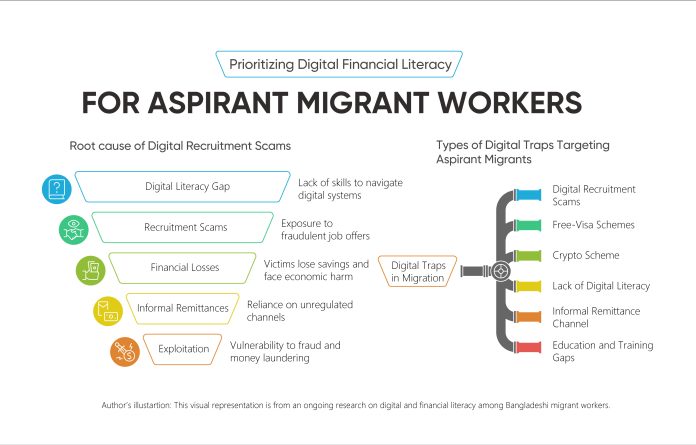
The dreams of thousands of Bangladeshi migrants have become a harsh reality — turning migration journeys into digital traps. Unfortunately, digital platforms that once promised safer routes to overseas work — job portals, messaging apps, and social media pages — now serve as the front doors to sophisticated fraud networks.

Multiple reports from 2024 and 2025 indicate that digital recruitment scams have evolved significantly, moving far beyond simple fraud into complex operations. Criminal organisations had used fake job offers to lure workers to locations where they were then coerced into participating in further scam operations, creating layers of victimisation.

Read More

Originally published at Dhaka Tribune in December 2025

When dreams meet digital recruitment scams: Bangladeshi workers in crisis

0
Migrants
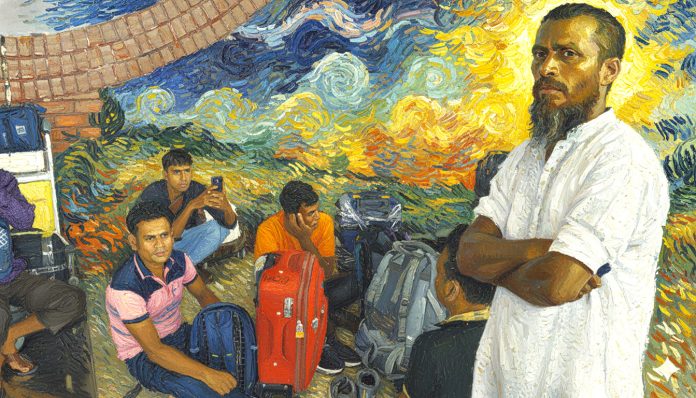
A migratory worker waits for his flight at Dhaka International Airport. Image via Wikipedia by Faisal Akram. CC BY-SA 2.0.

In the dim glow of his smartphone screen, the job advertisement seems perfect. Good salary. Reputable company. The application process is deceptively simple. A young man in rural Bangladesh reads it again, his heart racing with hope. He cannot yet see that this moment — this single click — may decide whether his family’s sacrifices lead to prosperity or unmanageable debt.

Bangladeshi migrant workers have always been vulnerable to fraud, but digital technology has transformed the scale and speed of deception. Fake recruitment schemes, online betting traps, and identity theft now reach even remote rural villages of Bangladesh through social media, mobile apps, and messaging platforms.

Read the full article, published at Global Voices on 30 November 2025.

Stages of Misinformation: An Analysis of Digital Deception across the Migrant Lifecycle in Bangladesh

How low digital financial literacy fuels migrant scams

0
Digital Deception and Migration Journey

Digital and financial literacy is mandatory if we want to safeguard our migrants from digital deception. When migrants learn simple habits, how to verify a website, how to refuse pressure to pay into a personal account, and how to use reputable remittance services, they become harder targets.

When migrants lose money to scams, the damage goes well beyond the individual. Families start new debts and sometimes sell land to make up the loss. These stolen funds hide the real picture of the economy at a national level. The psychological toll is no less real: victims report shame, isolation, and a lasting reluctance to try again. In short, low digital and financial literacy does not just cost money; it costs future opportunity.

Read details

From Verification Labs to Community Voices

0
Community Voice
From Verification Labs to Community Voices

Zulker Naeen is an interdisciplinary researcher whose career traces a deliberate movement from communications practice into evidence-led scholarship and grassroots engagement. He teaches and mentors at the University of Liberal Arts Bangladesh while coordinating research at the Centre for Critical and Qualitative Studies and leading Fact-Watch initiatives that connect academic rigour with civic impact.

His work is defined by a commitment to translate methodical inquiry into tools and trainings that strengthen local information ecosystems, empower community reporters and bolster democratic resilience across Bangladesh.

His research journey has concentrated on the anatomy of information disorder. Moving beyond descriptive accounts, he investigates how misinformation and disinformation propagate across platforms and borders, how influence operations exploit social cleavages, and how synthetic media reshapes evidentiary practice.

This scholarship is practice-oriented: mixed-method projects combine qualitative fieldwork, content analysis and open-source digital forensics to reconstruct misinformation supply chains and to generate curricula and verification toolkits that are usable by journalists, educators and civil society practitioners.

In parallel to his scholarly output, he has convened and contributed to regional collaborative efforts that interrogate cross-border narratives and coordinate collective response strategies.

At the grassroots level, his work has translated into tangible interventions designed to build civic capacity. He has led community-focused programmes that teach verification workflows, run fact-checking schools for emerging journalists and co-designed media literacy curricula tailored to the social and linguistic contexts of local audiences.

These initiatives deliberately centre local actors: community educators, student reporters and grassroots media outlets are trained not merely to spot falsehoods but to assemble traceable evidence, to document patterns of coordinated inauthentic behaviour, and to design locally-relevant reporting that restores trust and accountability.

As an independent journalist and storyteller, he situates investigative reporting at the intersection of climate, migration and information integrity. His reporting has highlighted the links between environmental shocks, displacement and the politicisation of narratives that circulate online and offline.

These stories inform his teaching and training, providing students with case studies that illustrate how misinformation can exacerbate vulnerability and how rigorous reporting can create openings for policy dialogue and community resilience.

Zulker’s portfolio also foregrounds gender and migration as analytic lenses. In both research and outreach, he applies gender-sensitive safeguards and advocates for inclusive pedagogies that protect marginalised voices while improving the evidentiary quality of public debate. These concerns sit alongside his work on democracy studies and digital citizenry, where he argues that strengthening media literacy and verification capacity is a prerequisite for healthy civic participation in the digital age.

Throughout his career, he has woven together roles as a curriculum designer, trainer, OSINT practitioner and convener of regional collaborations. From programmes that empower community journalists in Cox’s Bazar to cross-border symposiums that map transnational misinformation, his work demonstrates a consistent principle: research must be actionable, and action must be informed by rigorous evidence.

For institutions, funders and academic committees seeking a practitioner who combines scholarly depth with programmatic impact, his record shows an ability to design, implement and teach interventions that address the complex, interlocking challenges of information disorder, civic resilience and ethical storytelling.

Portfolio: Disinformation Studies, Digital Forensics, and Digital Citizenry

1
Digital Citizenry
Bridging Research & Practice in Disinformation Studies and Digital Citizenry

Zulker Naeen is an interdisciplinary researcher and development practitioner whose academic formation and professional trajectory sit at the confluence of Disinformation Studies, Digital Forensics, and Digital Citizenry

He completed a Bachelor’s in Media Studies & Journalism and a Master’s in Communication at the University of Liberal Arts Bangladesh (ULAB). He later expanded his theoretical grounding with a Master’s in Development Studies from the Independent University, Bangladesh (IUB). This combination underpins his work, bridging scholarly inquiry and field-facing practice.

This layered disciplinary foundation enables him to deploy communication theory, journalistic method and development frameworks in the analysis and design of interventions that address information disorder, civic literacy and socially-rooted media problems.

As a faculty member in the Department of Media Studies and Journalism at ULAB and as Research Coordinator at ULAB’s Centre for Critical and Qualitative Studies (CQS), he teaches and mentors on courses that synthesize strategy, ethics and technique—Strategic Public Relations, Communications for Development, Critical Thinking and Logic, Fact-checking and Digital Forensics, and Independent Journalism—preparing students to move fluidly between newsroom practice, public-interest investigation and policy-relevant research.

His classroom practice is informed by hands-on verification work and project leadership carried out through Fact-Watch and regional collaborations, where he helps translate empirical research into teachable modules and active learning exercises.

Zulker’s research focus is organised around Digital Media and Information Studies, Synthetic Media Studies, Digital Literacy and Digital Citizenry, and their intersections with gender, democracy and civic participation.

He studies how narratives move across platforms and borders, how synthetic media technologies alter evidentiary practices, and how gendered power relations shape both the production and effects of false information; his writings and policy commentaries articulate the theoretical stakes while proposing concrete institutional and pedagogical responses.

In published essays, he has traced the transnational dynamics of disinformation in South Asia, argued for whole-of-society approaches to fact-checking, and documented how misinformation is weaponised against women—each piece grounded in empirical observation and oriented toward practice.

Practically, his work blends qualitative field research with open-source digital forensics and OSINT techniques. He leverages mixed methods—ethnographic interviews, content and discourse analysis, geolocation and metadata verification—to reconstruct information supply chains and attribute patterns of coordinated inauthentic behaviour.

Throughout his career, he has actively translated research into curriculum and capacity building. He has designed specialised training modules and short courses on basic fact-checking and verification toolkits for grassroots practitioners; these pedagogical products are tailored to the needs of journalists in Bangladesh and the broader South Asia region, and are deployed in workshops, fact-checking schools and university classrooms.

His curriculum development emphasises locally-situated problem sets, hands-on verification labs, and gender-sensitive safeguards, ensuring that training is both technically rigorous and ethically attentive.

At the same time, his leadership in regionally focused projects—such as contributing to a draft strategy for South Asian collaboration on transnational misinformation—illustrates how his scholarship moves beyond description to institutional design and policy engagement.

That pathway equips him with a rare combination of strategic communications skills, investigative craft, and curriculum design expertise, enabling him to operate as an interdisciplinary researcher-development practitioner who can convene scholars, train journalists, advise policymakers and support grassroots actors.

In public fora and peer networks, he positions Disinformation Studies as an applied, action-oriented discipline—one that requires methodological pluralism, ethical reflexivity and sustained investment in digital literacy and civic capacity.

His work, therefore, insists that solutions to information disorder must integrate pedagogical interventions, verification infrastructures, cross-border cooperation and gender-aware policies, and his published commentaries and project briefs offer concrete recommendations for each of these domains.

Synthetic Media Observatory: A New Frontier in Digital Truth

0
Synthetic Media
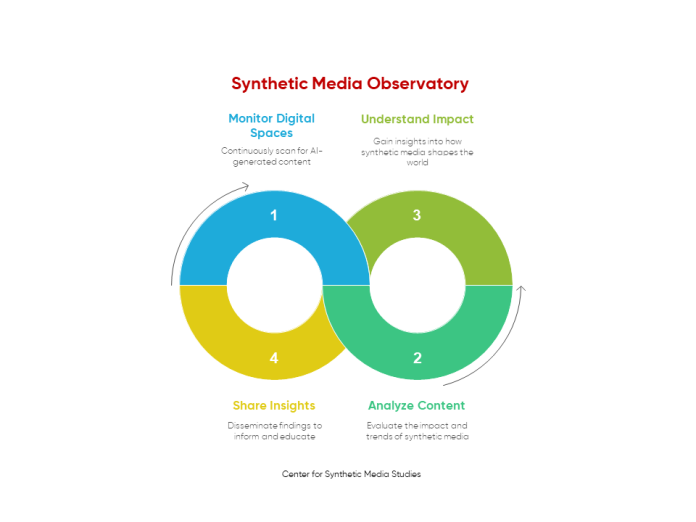
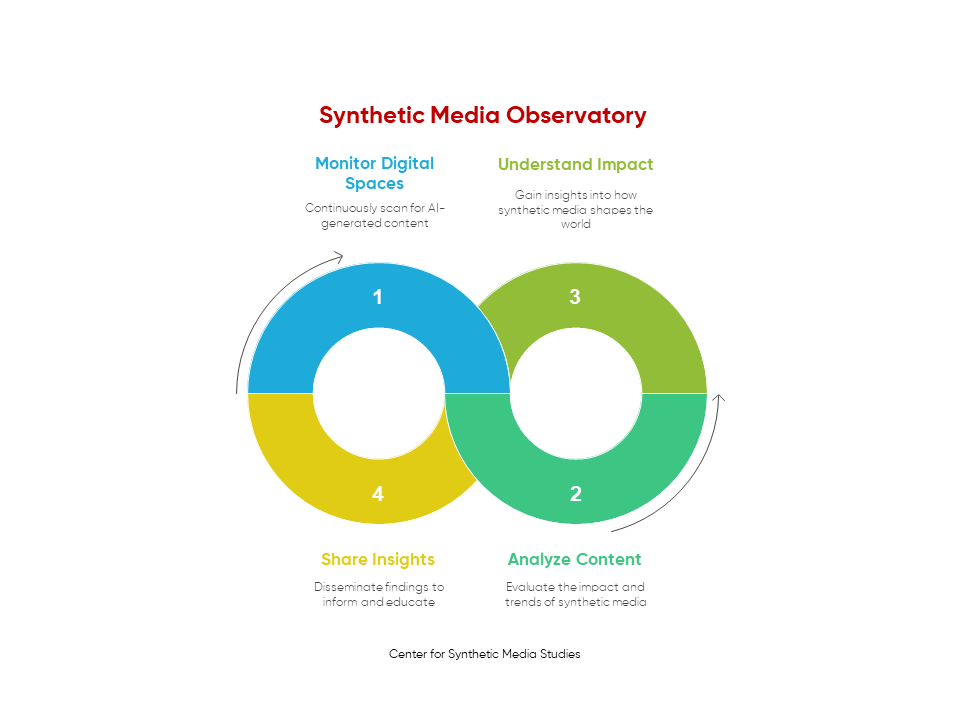
Synthetic Media Observatory
Synthetic Media
Synthetic Media Observatory – Institutional Profile

The Synthetic Media Observatory emerged in 2025 as a response to the exponential growth of AI-generated content across digital platforms. Recognising that synthetic media—ranging from deepfake videos to AI-generated text—poses unprecedented challenges to information integrity, democratic discourse, and social trust, a consortium of leading researchers, technologists, and policy experts established this groundbreaking research organisation.

The Observatory’s mission centres on three core pillars: advancing detection capabilities, fostering media literacy, and informing ethical policy frameworks.

Legal Name
Synthetic Media Observatory (SMO)

Year of Establishment
2025

Founders / Founding Members
Established by a consortium of leading researchers, technologists, and policy experts concerned with the rise of AI-generated content and its risks to democracy, trust, and information integrity.

Founding Purpose
To respond to the exponential growth of synthetic media by focusing on:

  1. Advancing detection and authentication technologies
  2. Fostering media literacy
  3. Informing ethical policy frameworks

Place of Origin
Dhaka, Bangladesh

Original Structure
Founded as an independent research consortium/observatory, functioning as a nonprofit, interdisciplinary research body.

Vision Over Time
While the initial mission centred on detection and policy engagement, the Observatory has expanded into preventive technologies, economic impact studies, and democratic resilience initiatives.

Notable Leaders

Zulker Naeen and Rezwan Islam

Governance Structure

Operates under a multidisciplinary board of directors with five interconnected research divisions. Governance emphasises collaborative partnerships across academia, civil society, and industry.

Strategic Priorities

Looking ahead, the Observatory will expand its focus areas:

  • Preventive Technologies: Developing provenance systems that embed authenticity markers at the point of content creation
  • Economic Impact Analysis: Quantifying the costs of synthetic media proliferation across industries and regions
  • Democratic Resilience: Partnering with electoral commissions and civil society groups to protect democratic processes from synthetic media manipulation

Geographic Reach
Plans for regional observatories in the Asia-Pacific.

Affiliations/Partnerships in History

  • Academic institutions (e.g., University of Liberal Arts Bangladesh, FactWatch, Engage Media)
  • Law enforcement collaboration
  • Technology and media industry partnerships

Funding Sources
Mix of research grants, institutional partnerships, philanthropic foundations, and industry collaborations.

Community
Initially perceived as a niche research body, it has quickly gained recognition as a leading global authority on synthetic media.

Legacy or Cultural Significance
The Observatory stands as a first-of-its-kind global hub for tackling the synthetic media crisis. Its work has direct cultural and democratic significance, preserving digital truth, information integrity, and public trust in an era where real and fake are increasingly indistinguishable.

Grassroots Model to Counter Misinformation: A Community-Centered Movement

0
Grassroots
FactWatch

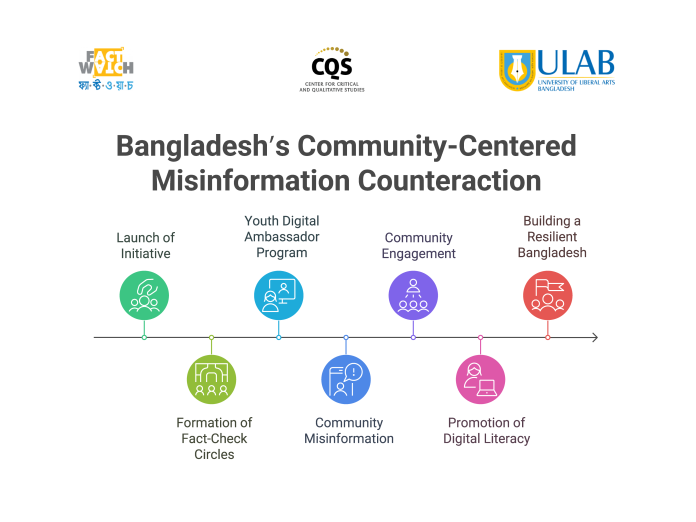
In an age where misinformation spreads faster than truth, empowering communities with the right tools and knowledge is no longer optional—it’s essential. FactWatch, Bangladesh’s IFCN-certified fact-checking platform, in collaboration with The Centre for Critical and Qualitative Studies (CQS) at the University of Liberal Arts Bangladesh (ULAB), has launched the country’s first grassroots model to combat misinformation at the community level.

Introducing Connecting Communities: Empowering Bangladesh Against Misinformation—a pioneering initiative designed to build digitally aware, critically thinking, and resilient communities capable of identifying and challenging digital falsehoods from the ground up.

It is a movement—rooted in local contexts, driven by local voices, and built for national impact. It is Bangladesh’s first systemic approach to fight misinformation from within the heart of communities, towns, and villages, instead of top-down messaging.

🚀 The Model in Action: Key Components

✅ Community Fact-Check Circles:
These are local clusters formed to detect, verify, and challenge misinformation that circulates through word-of-mouth, social media, and messaging apps. Trained members work collaboratively to promote verified narratives and spread awareness at the neighbourhood level.

Youth Digital Ambassador Program:
This initiative taps into the power of youth leadership by recruiting and training young volunteers across Bangladesh. These ambassadors act as frontline defenders, promoting digital literacy, fact-checking skills, and ethical online engagement in their schools, colleges, and communities.

Community Misinformation Hotline:
A direct and accessible channel where citizens can report suspicious content or seek guidance. Operated in partnership with FactWatch’s verification team, this hotline empowers the public to question and challenge misleading narratives.

👉 Be part of the solution. Follow, share, and join us:
🔗 Facebook Group: Empowering Bangladesh
🔗 LinkedIn: Empowering Bangladesh

#ConnectingCommunities #StopMisinformation #DigitalLiteracy #EmpowerWithFacts #ResilientBangladesh #CommunityResilience

error: Content is protected !!